Encourage Spanish readers to practice multiplication, division, and fractions while learning all about bread through this digital book! Readers can apply multiplication, division, numbers and operations, and STEM skills throughout this informational text filled with practice problems and interesting facts about wheat grain, nutrition, bakeries, and more. With an accessible glossary, vibrant images, clear mathematical diagrams, a historic timeline of bread throughout the world, and easy-to-read text, this Spanish-translated e-book will engage readers and show them how to apply mathematics to their daily lives - even to what they eat!

A forest is unlike any other biome on Earth. There are many life cycles found within a forest. Learn about the energy pyramid that explains the numbers of forest plants and animals. Learn about threats to these lively forests and how they thrive and survive!

Deserts may seem like harsh, uninhabitable places, but actually they support a diverse quantity of plant and animal life. And, they aren't always hot! Deserts serve an important role in Earth's existence, too. Readers learn about hot and cold deserts alike, as well as semi-arid and coastal deserts. From the Horned Lizard to the Saguaro cactus rooted in rich soil, the desert biome will amaze readers.

Perhaps nothing is more frightening than seeing a forest fire rage out of control. Sometimes, however, fires are set intentionally to benefit the environment. Readers will learn what fire is, how it burns, and how fires can both help and harm the areas they affect.

Floods and blizzards may be very different, but they do have some things in common. In this book, readers will discover they have one vital ingredient in common: water. Readers will learn the powerful forces of water as it pertains to floods and blizzards. They also discover that although these two forces of nature can cause difficulties for people, they are nature's way of cleaning up and re-nourishing the land.

Images of an erupting volcano can be mesmerizing. Readers may be surprised to learn that volcanoes erupt every day. Some erupt constantly, while others lie dormant for years or even centuries. Through engaging text and brilliant photos, readers learn what happens beneath the Earth to cause a volcanic eruption and the different structures beneath the Earth that cause new land to form.

Most of the Earth's changes happen over millions of years, but earthquakes can force significant changes to the land in just a few moments. Readers will learn the science of plate tectonics and its role in the development of earthquakes around the globe. They will also learn that not all rocks are created equal. In fact, rocks are all different ages! This book concludes with images of the damage and destruction that earthquakes can cause.

This book will be a hit with both thrill seekers and with those who prefer to stay safely on the ground. After an introduction to Newton's three laws of motion, readers learn the mechanics of various amusement park rides including roller coasters, Ferris wheels, merry-go-rounds, and gravity rides. They learn how to measure motion, and how kinetic and potential energy apply to their favorite rides.

Learn about estimating multidigit numbers by using data from newspapers! Newspapers are full of data, including graphs and tables pertaining to weather, lifestyle, currency, sports, and more! This Spanish-translated title shows young readers different types of data relating to newspapers through clear mathematical diagrams and charts. Extensive examples and diagrams help simplify estimation, data collection, and various STEM themes, leaving readers ready to practice making their own estimations.

Learn how wildlife scientists use graphs, charts, and data analysis! It is important for wildlife scientists to assess probability and more when working with wild animals like polar bears and chimpanzees! This Spanish-translated title uses mathematical diagrams and charts to improve readers' data analysis and STEM skills. Learn about Jane Goodall's work in chimpanzee conservation! Accurate data analysis is essential to her work and the work of many other scientists! These exciting examples will engage readers, while practice problems and clear diagrams will make them more confident in their own data analysis skills.

Three-dimensional shapes are everywhere! Learn about the properties of three-dimensional shapes like cylinders, prisms, cubes, and cones with this vibrant book. This title has been translated into Spanish and encourages young readers to practice geometry and STEM skills, teaching them how to identify familiar three-dimensional shapes and find bases, faces, vertices, and more! Vibrant images, simple practice problems, and clear mathematical diagrams help readers while encouraging them to find three-dimensional shapes all around them!

Learn about two-dimensional shapes by identifying them in famous works of art! Young readers will practice and enhance their geometry and STEM skills, identifying shapes and familiarizing themselves with new concepts and vocabulary terms like angles, tangrams, and lines of symmetry. This book has been translated into Spanish and provides clear diagrams and vibrant examples that will teach children about geometry and art simultaneously, while making them feel more confident in their mathematical skills. Follow-up activities encourage children to use two-dimensional shapes to make their own geometric works of art!

Learn how to budget a vacation with this informative title! This Spanish-translated book uses exciting images, practice problems, mathematical diagrams, STEM topics, and a helpful glossary to teach young readers how to calculate expenses and use the decimal system to create a budget for a family vacation that is eight weeks away! Children can practice their developing mathematical skills by using a budget to determine how much money the family should save each week before the trip. This book teaches readers very important principles of budgeting that they will be able to use in their daily lives.

Follow a class field trip to a park where students study and investigate different animals! Data is collected on dragonflies, honeybees, ducks, sparrows, rabbits, and chipmunks, and then predictions are made. Diagrams, charts, tables, and graphs are useful tools for organizing data! With vibrant photos, grade-appropriate text, and informational text features to help navigate the text, students will learn practical, real-world applications of math skills as they learn data collection and build their STEM skills.

Learn about estimating multidigit numbers by using data from newspapers! Newspapers are full of data, including graphs and tables pertaining to weather, lifestyle, currency, sports, and more! This title shows young readers different types of data relating to newspapers through clear mathematical diagrams and charts. Extensive examples and diagrams help simplify estimation, data collection, and various STEM themes, leaving readers ready to practice making their own estimations.
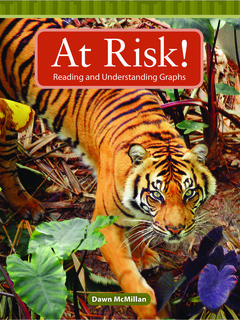
Learn about endangered animals such as the Sumatran tiger, the ivory-billed woodpecker, the northern white rhinoceros, and the leatherback turtle. As you learn more about these animals, you will also read and interpret graphs and charts that show important information about them. With vibrant photos, math charts and diagrams, grade-appropriate text, and informational text features to help navigate the text, students will learn practical, real-world applications of math skills as they learn to read graphs and build their STEM skills.

Learn how wildlife scientists use graphs, charts, and data analysis! It is important for wildlife scientists to assess probability and more when working with wild animals like polar bears and chimpanzees! This title uses mathematical diagrams and charts to improve readers' data analysis and STEM skills. Learn about Jane Goodall's work in chimpanzee conservation! Accurate data analysis is essential to her work and the work of many other scientists! These exciting examples will engage readers, while practice problems and clear diagrams will make them more confident in their own data analysis skills.

Find three-dimensional shapes all over New York City! This exciting title shows young readers where they can find cylinders, cones, prisms, spheres, and pyramids in the city. Vibrant images, simple practice problems, and clear mathematical charts and diagrams help make geometry and STEM themes seem simple and fun! These exercises will encourage children to practice their geometry skills by finding three-dimensional shapes in their own city!

Three-dimensional shapes are everywhere! Learn about the properties of three-dimensional shapes like cylinders, prisms, cubes, and cones with this vibrant book. This title encourages young readers to practice geometry and STEM skills, teaching them how to identify familiar three-dimensional shapes and find bases, faces, vertices, and more! Vibrant images, simple practice problems, and clear mathematical diagrams help readers while encouraging them to find three-dimensional shapes all around them!

Learn about two-dimensional shapes by identifying them in famous works of art! Young readers will practice and enhance their geometry and STEM skills, identifying shapes and familiarizing themselves with new concepts and vocabulary terms like angles, tangrams, and lines of symmetry. This book provides clear diagrams and vibrant examples that will teach children about geometry and art simultaneously, while making them feel more confident in their mathematical skills. Follow-up activities encourage children to use two-dimensional shapes to make their own geometric works of art!

Learn how to budget a vacation with this informative title! This book uses exciting images, practice problems, mathematical diagrams, STEM topics, and a helpful glossary to teach young readers how to calculate expenses and use the decimal system to create a budget for a family vacation that is eight weeks away! Children can practice their developing mathematical skills by using a budget to determine how much money the family should save each week before the trip. This book teaches readers very important principles of budgeting that they will be able to use in their daily lives.

Readers learn the importance of budgeting money and how the decimal system works in this informative title that features a variety of lively photos, easy-to-read text, STEM topics, and helpful mathematical charts. The familiar real-life examples of expenses, income, and saving will help readers learn how to create their own budget, while the challenging practice problems provide plenty of opportunities to practice their developing mathematical skills--from addition to decimals.

Hippocrates is often referred to as The Father of Medicine. This captivating biography highlights the life and accomplishments of Hippocrates and how he had a major impact on the world of medicine. Along with learning about his belief in the four humors, his discovery of pneumonia, and the Hippocratic Oath, readers will also learn about some other inspirational scientists who made leaps in the medical field. Featuring colorful images and easy-to-read text working in conjunction with intriguing facts and a stimulating lab activity, this book will have children eager to learn more!

George Washington Carver was a skilled botanist who became famous for his work with peanuts and other plants. Readers will discover the captivating life of this incredible scientist in this engaging Spanish scientific biography. Using colorful photos and graphs, English language learners will learn why Carver was known as "The Plant Doctor" as a child and how his work with peanuts, sweet potatoes, and pecans helped change the way people used plants. The helpful glossary and index aid in better understanding of the content, while a simple, interesting experiment leaves children engaged and excited to learn more!

Many scientists have dedicated their lives to finding out how cells work. In this appealing book, readers will learn about scientists whose research on cells has made a big impact on the world of science. Robert Hooke, Joan Wright Goodman, Mathias Schleiden, Hans Krebs, Gerty and Carl Cori, Rita Levi-Montalcini, Stanley Cohen, and Elaine Fuchs are some of the inspiring scientists that are featured, as well as such topics as cell theory and DNA. The vibrant photos, fascinating facts, and engaging sidebars work in conjunction with the easy-to-read text, accessible glossary and index, and captivating hands-on lab activity to provide readers with an inviting reading experience that will leave them eager to learn more!